Monday, June 10, 2013

Tomasello Pasta Factory


Today we were able to visit the only pasta factory throughout Sicily, the Tomasello Pasta factory. This company creates several different brands including the brand they sell at Trader Joes and Barilla pasta. They use only Sicilian wheat and the company actually began as solely a wheat storage facility. The pasta is first dried at a low humidity of 10% and then is cleaned to remove the seeds. The sorting process then begins and is followed by all of the cleaning regimens. After the cleaning, there is a eight hour resting period before being passed through the roller mill to grind up the wheat. Humidity is then added and the wheat is pressed and sent to the machines to be cut into the 70 different varieties of shapes that they create. We actually got to walk through the factory and see each one of these steps. The process is so quick and the amount that they produce each day is just incredible. The absolute capacity of the factory is 5000 tons of pasta. The thing that interested me the most was that Tomasello exports 60% of what they produce.
Italian factories are much different than American factories in several ways. For one, they do not have the precise safety standards of OSHA that the United States has to follow. When we were walking around the factory there was no protection between the machines and us. I could have easily walked right up to the pasta and touched it with my bare hands without anyone saying anything to me. Also, the machines were very loud and I noticed that none of the employees were wearing ear protectors. I guess things really are different in Italia!
It was so great to finally see the exact steps in where our pasta supply comes from. These are the things you wonder your whole life and sometimes never get the answer! Fortunately for us, WE DID! I am so looking forward to what the rest of this trip has in store for us!

-Hannah Auer

Marsala Wine


Marsala Wine

An enthusiastic tour guide can really enhance your experience while studying abroad!  Our group had the pleasure of receiving an amazing tour of the Florio Winery on Friday.  It was by far my favorite out of all the tours we went on in Sicily.  Our guide painted a wonderful picture of the history and production of Marsala wine.  The Florio Winery was the most unique out of all three wineries we have visited so far. 
The Florio Winery is located on the western coast of Sicily.  The production began in 1833 with Vincenzo Florio.  The Florio family was a very prominent Sicilian family for several generations.  The winery does not belong to the Florio family today, but still bears the name. 
Marsala wine is a fortified with alcohol which makes it different from table wine.  It  is produced using white grape varieties.  The different classifications of Marsala wine are based on the aging, the sweetness, and the color of the wine. 
The Florio Winery is unique in the fact that they produce Marsala wine.  There is a particular art that goes into creating Marsala wine from how it is aged to the type of cellars that the barrels are kept in.  Our Tour guide informed us that enough space is left in the top of the barrels to aide in the oxidation and aging process of the wine.  I found it interesting the way the wine cellars were designed.  The floors and ceilings of the cellars are constructed in a way that keep the humidity level low, and to keep the cellar cool.  The construction of the cellars is the only thing controlling the climate for aging the wine.  Even though it was warm outside the wine cellar was pretty chilly.  The guide laughed at the fact that most of us were wearing shorts.
At the end of the tour we were invited to taste two different types of wines.  Marsala Vergine was the first type of Marsala we tasted.  It was paired with parmesan cheese.  The second wine we tried was Marsala Semisecco.  This was sweeter than the first, and was paired with a dipping cookie.  After the tasting we visited a shop filled with their products.  Our guide mentioned that they did not export to the United States, so I purchased a bottle of the Marsala Vergine for my family to try!  The Florio Winery was beautiful, and was a great experience. 

- Emily Darling

Marsala Semisecco and Marsala Vergine
 

Vino


     What is the first thing you think of when you hear the word “Italy”? For some, it might be the beautiful scenery or architecture, while for others, Venice and it’s gondolas or he Vatican may come to mind.  When I hear the word Italy, an array of things pop into my head, but Italy’s rich winery culture is the most prominent. 
     Located in the region of Sicily and the city of Marsala (located just a few kilometers from the city of Trapani, on the western coast of Sicily), Florio Winery has been in continuous Marsala wine production since 1833. Through our energetic and passionate tour guide and the atmospheric environment, we soaked in the rich history and culture of the prominent Florio family. Although this winery has had a few different owners, its tradition for quality still holds strong. 
     Our tour guide, Sarah, was definitely a highlight of this winery tour. Her strong Italian accent seemed to make the rich history come alive. We learned the Florio family was in control of this winery for many generations until they sold every possession their family owned, including the winery, so they didn’t have to declare bankruptcy. Because of this noble and unheard of action, the Florio family was honored. Many years later, during World War II, the winery was mistaken for a military hangar and bombed, resulting in tremendous loss. A few casks were spared from the bombing, resulting in small amounts of these wines still in the cellars to this day. Now, your probably thinking that it would be really cool to buy a bottle of this culturally rich Marsala, but that won’t happen, ever. These reserve wines are kept only for prominent people, only people who the president of the company allows to buy (not some random guy who wants to blow hundreds of euro on a bottle of Marsala). One of these reserve wines in particular was limited to a production of 1,000 bottles total and sold at a whopping 500 euro ($663 at the current exchange rate). There are two small casks left of this particular wine, but it will not be bottled and sold any time soon. Sarah explained that if and when this Marsala is bottled again, the price would definitely increase. After being immersed in the rustic cellars and rich culture of the Florio Winery, I had to buy a bottle of Marsala to share with my parents!

-Taylor R


Driving on Italian Roads


There is something to be said about the way Italians drive. It seems to me that they all have the skills of professional stunt drivers!  They speed their Fiats, Peugeots, and other models around corners and other cars with literal inches separating them while mopeds flow past obstacles like ants on a disturbed mound.   This display of vehicular handling is both a wonder to behold as well as the cause of heart attacks.  However, handling cars are one thing while modern busses are quite another. Like a puzzle master, these drivers can fit modern busses into and through lanes made over a thousand years ago solely for pedestrians. How I have not yet witnessed destruction yet i cannot tell you.

I greatly admire the skills these people posses, but as a pedestrian I have had my fair share of frights and close calls, keeping my head on a swivel.  However, this awareness has allowed me to take in more of the sights and sounds of Italy, greatly enhancing my experience and for this I thank them.

- John Langford

First day of touring in Sicily: June 4


Needless to say, I've talked nonstop for this past semester about my excitement for this Horticulture Study Abroad trip and the amazing experiences that we will learn from. I now am seeing that this description is a major understatement. Today was deliciously exhausting, as we ate infinite amounts of Italian delicacies and toured three factories where Italian horticultural products are produced. We started our day with a home-cooked breakfast, which included about eight different types of delicious coffee cakes, extremely strong coffee, and local juices. Our first stop of the day was the local pistachio factory, where we learned lots about the production of pistachios. We also learned about the different ways to eat a pistachio…and we went to town on the samples of sun-dried pistachios, pistachio butter (surprisingly delicious), cookies, cakes, liqueur, and, of course, pistachio gelato. I really couldn’t get enough—that is, until I had had enough. After scarfing down every pistachio dessert that they handed us, I realized that I could probably last for years if I never had to eat another pistachio again. Of course, we had a pistachio-themed seven-course meal for dinner at night, but that’s a different matter.

After the pistachio extravaganza, we made our way to a restaurant for lunch, and proceeded to take many obnoxious and touristy pictures in front of the beautiful view. It was well worth the disgusted stares that we got from the local diners, though, since the scenery was breathtaking. Our enormous group then made our way to the next stop: an organic honey farm. Bees swarmed about 200 yards away from us in colorful boxes, while the owners explained that they moved those boxes around the countryside, creating different types of honey based on the different flowers that the bees pollenate. Some varieties included orange, lemon, bee balm, eucalyptus, chestnut, and multi-flower honeys, which are created by placing bees in a large orchard that produces only certain organic fruits. The hives and bees are then removed, and the honeycombs are stripped of the wax and placed in a large centrifuge that can extract up to three tons of honey every eight hours. We had an extended period of taste testing and an opportunity to buy different types of honey, which I can't wait to bring home and show my family. 
Molly Mitchell


Sunday, June 9, 2013

Reminds me of home...

I really like seeing something that reminds me of home; it makes me more comfortable. Most of the music playing in shops and at bars is American. It’s interesting to me that they prefer to play our music. I guess the US does well in exporting its culture.

When driving from the airport to the first agriturismo in Sicily there is desert vegetation reminding me of New Mexico. Rather than trees there are large shrubs along with cacti and yucca or century plants surrounded by brown grasses. The cacti are in larger clusters than in Albuquerque. But they have the same large pad, sparse needles, and purple fruit. They also have the same waxy, colorful flowers as at home. 


The yucca here are larger than home with lighter coloring and thicker leaves. Also their blooms grow taller and into inflorescence of tiny flowers whereas at home they may be two feet with white, waxy, bulbous flowers growing an inch or so long and attracting ants. One of the grasses here is very similar to Albuquerque. It has a long stem with a row of seeds pointing downwards. 


What's interesting is if you travel to a different area you'll find large trees, green grasses, and many flowers. There are even palm trees which I never would have expected in a place that has cacti. The vegetation is very dependent on location and it is fun to watch it change while driving around Sicily. 

- Shannon Murray

Italian Public Transport - What a Ride!

I must say, it has been an adventure here in Italy so far. We, as a group, decided to head to Amalfi for the day today and see the city.  We spent an enjoyable afternoon enjoying the sun, the sea, and the scenery, but the true entertainment (at least for me) was the bus ride back.

The crowd for the bus for Sorrento began to form early and the crowd swelled for a good while.  Every bus that arrived was greeted by a throng of locals and tourists seeking the bus. We were dissapointed several times, but finally our bus arrived. As the door opened, people swarmed the entrance.  It didnt matter age or gender, everyone was pushing everyone else. Ultimately, packed like sardines, the bus began to move. The first leg was as enjoyable as this packed bus could be, but several stops in the real drama began.  For reasons unknown, two women began to argue about available space on the bus and ultimately clogged the doorway preventing the bus doors from closing.  A heated argument ensued with many a hand gesture and it escalated quickly. More people got involved, yelling ensued, and ultimately the bus driver took his leave for a cigarette break, leaving the bus in the middle of the lane.  He returned thirty minutes later with the argument still in full swing. The rest of us got ansy during this time period and entered our opinion while simultaneously filming the event on our assorted devices.

It is important to note that we were still in a bus and clogging the rode, so it seemed everyone within a mile on either side was upset. The honking and general anger added itslef to the cacophony of sounds creating a vivid and passiote Italian argument. Finally, the polizia showed up and settled the situation peacefully while allowing us to get on the move again. The rest of the trip went on with only occasional outburts from the lady earlier.

Whether cooking, or fighting for a place on a bus, it is true Italians put passion into everything they do!!

In all, this situation has given us an interesting case study of Italian mass transit and memories to last us a lifetime!

- John Langford

Saturday, June 8, 2013

When Italy gives you lemons, make Limoncello.

Ciao from Sorrento!

Today we took the early flight to Napoli, and arrived in Sorrento just in time for lunch.  We enjoyed our first bites of true Italian pizza on the patio outside of our hotel. The weather was perfect, and the view was even better. Once we were done most of us parted ways to check out the area.  I walked around a few shops and almost every store sold some form of Limoncello. Recently, I learned that Sorrento is very famous for it's production of Limoncello.  Why? Well, they have tons of lemon production.  Try to imagine lemons in the United States, but the size of your head. These lemons don't mess around, they are huge! Okay, so what is Limoncello, you may be asking yourself. Limoncello is mostly served cold in a frosted small glass, and after a meal as a digestive citrusy drink.  It is made by gathering some lemon rinds, 100-proof alcohol, sugar, and water.


The lemons here grow much larger than in the States because of the perfect soil mixture in which these lemons are propagated.  Not only does the soil provide an ideal cultivation of lemon trees, but it also gives the lemons a sweeter taste as opposed to the tart taste we're accustomed to.


Overall, Limoncello seems like a very interesting, and creative use of their abundant supply of lemons. I really enjoyed seeing the vast products stores provided, and their creativity when it came to advertisement!

-Jenna Rios

Friday, June 7, 2013

Olio di Oliva

Howdy from Palermo!


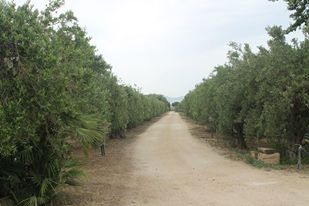
The rows of olive trees.
A little baby olive.

Today is June 6th and today also happens to be the day we set off for our adventure to the local organic olive oil farm. When we arrived we were welcomed with not just hundreds, but thousands of olive trees. The rows seemed to have never ended.  We got off, stretched our legs and began our tour with the founder's daughter.  She was the quintessential Italian lady. I don't think I saw her put her hands down once while she was speaking, and she was SO sweet! She walked us out to the rows of olive trees and began her lecture.  Founded in 1936 by her grandfather, this farm was a trailblazer for its time. In the 80s her father started a revolution by growing olive trees instead of a vineyard.  

The daughter, her father, and our translator.
Currently, their plot is 19 acres and yields about 5,000 trees of 3 different varieties. She continued to tell us about the harvesting processes and what they do differently to be considered an organic farm.  Very animated, she began to tell us how critical it is to harvest right when the olives are turning from green to black.  It is critical because of the high anthocyanidins at that stage, the anthocyanidins give the oil a very wonderful spicy flavor. Now, I'm sure you're wondering, "How do they stay organic?" Well I have the answer for you. She explained to us the importance her father felt to maintain an organic farm. So she walked away for a few minutes to snatch up their form of pesticides.  She lifted up a large water bottle of some green, opaque solution. This solution consists of water, and sardines; that's it.  They tie theses bottles to the trees and leave them until they need to be replaced about 3-5 months later. As opposed to the weekly spraying of pesticides on non-organic farms. Everything she told us was just amazing.  After we ended our tour, we were greeted with the friendly farm donkey. At first he greeted us with a loud, "Heehaw, heehaw." But he warmed up to us eventually. We were able to sample their delicious product along with a few appetizers, and I don't think I've ever tasted oil that wonderful in my lifetime! Our trip to the olive farm was definitely educational, and I enjoyed every second of it.


-Jenna Rios


The farm donkey.


Tuesday, June 4, 2013

Aggie Hort is in Italy now and will be reporting soon!

Once in Italy, the group will first travel through Sicily.  The latter part of the journey will be at Santa Chiara in Castiglion Fiorentino, a small town in Tuscany and their trip will intersect with UT's Art history program.  They keep a blog, too: http://blogs.utexas.edu/learningtuscany/ .  The trip will wrap up in Rome.  So stay tuned for fresh Aggie posts...